The brutal terrorist attack on innocent tourists in Jammu and Kashmir’s Pahalgam has once again laid bare the deep-rooted malaise of cross-border terrorism. It has sharpened the debate on proportionality and response. Time after time, whenever Indian soil is stained with the blood of innocents by forces operating from across the border, the nation grieves, registers diplomatic protests, strengthens security protocols—and then eventually moves on. But this cycle of grief, outrage, and resignation cannot be allowed to continue indefinitely. There must come a time when excessive restraint, rather than serving as a virtue, begins to resemble silent complicity.
In the wake of the Pahalgam attack, the Government of India has undertaken a significant and long-overdue strategic shift: it has initiated the suspension of the Indus Waters Treaty (IWT)—one of the most asymmetrical and extraordinarily generous water-sharing agreements the world has seen. This move is not merely a shift in policy; it represents a fundamental recalibration of India’s strategic posture.
Signed in 1960, the Indus Waters Treaty belongs to a very different geopolitical era. Back then, newly independent India, as the upper riparian power, displayed an extraordinary act of goodwill by ceding near-exclusive rights to Pakistan over the waters of the Indus, Jhelum, and Chenab rivers—all of which originate from Indian territory. Despite repeated provocations—including full-fledged wars, covert terror campaigns, and ongoing diplomatic hostility—India steadfastly honored the treaty for over six decades. However, the era of automatic and unconditional generosity must now end. The suspension of the IWT signals a turning point—an era where cooperation must be tied to conduct, and dialogues must have consequences.
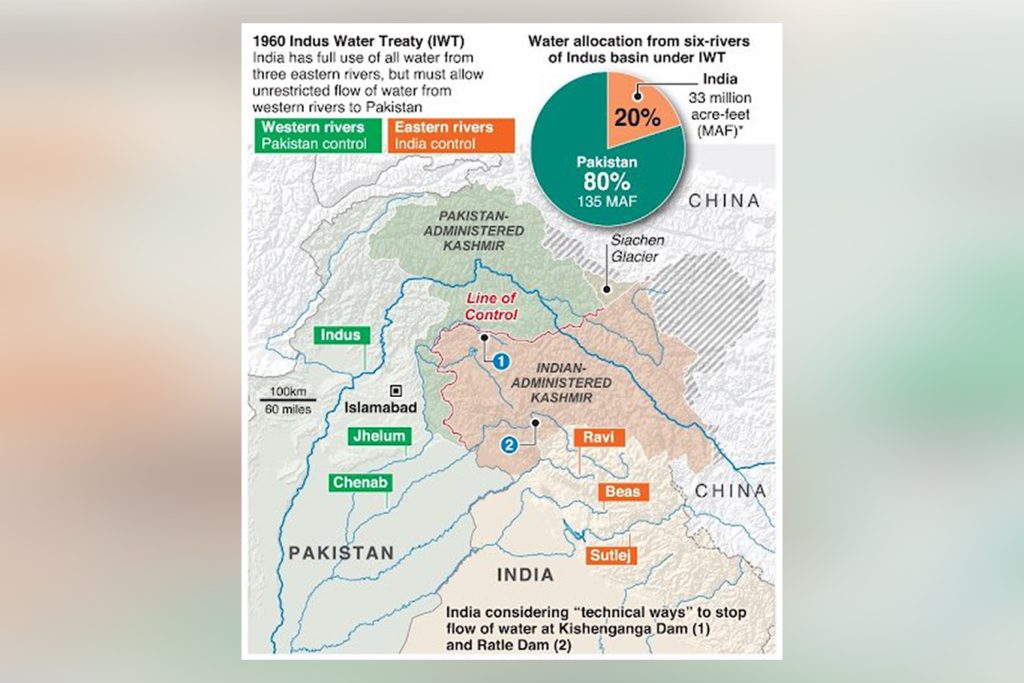
Another critical aspect that demands attention is the fundamental unfairness baked into the very structure of the Indus Waters Treaty itself. The treaty, astonishingly, allocated nearly 80% of the total waters of the Indus River system—approximately 135 million acre-feet of water annually—to Pakistan, even though the sources of these rivers originate predominantly in India. Under the agreement, Pakistan was granted full rights over the western rivers—Indus, Jhelum, and Chenab—while India was left with the eastern rivers—Ravi, Beas, and Sutlej—comprising only around 20% of the system’s total waters. Even India’s use of the western rivers was heavily restricted, confined to non-consumptive purposes like limited hydropower projects, with strict stipulations designed to ensure that flows into Pakistan remained uninterrupted.
In effect, India, as the upper riparian state, voluntarily imposed upon itself extraordinary constraints for the sake of regional peace—constraints that few other upper riparian countries anywhere in the world have ever accepted. Over the years, this asymmetric arrangement has not only curtailed India’s ability to develop vital irrigation and hydropower infrastructure, but it has also deprived regions like Jammu, Kashmir, and Ladakh of the full economic and developmental benefits that rightfully should have flowed from their geography. Meanwhile, Pakistan has built an entire agrarian economy on Indian-origin rivers, all the while sponsoring cross-border terrorism. Thus, the injustice is twofold—an inequitable distribution of a vital natural resource and a perverse incentive structure that emboldens hostility while reaping economic rewards.
Seen in this light, the Government of India’s decision to suspend the treaty is not merely a reaction to terrorism—it is a long-overdue correction of a historical wrong. It is a reaffirmation that generosity cannot be a one-way street and that national resources must first serve national interests.
The Jhelum River, rising from Indian glaciers, flows directly through the area where Pakistan-backed militants murdered Indian soldiers in Pahalgam. These waters, nourished by Indian soil and snowfields, eventually flow into Pakistan, nurturing its fields and energizing its economy. Yet, in return, India has been rewarded with cross-border infiltration, radicalization, and an unending spiral of bloodshed. The symbolism could not be clearer, and the strategic imperative could not be more pressing. The government’s decision to suspend the IWT is not a petty act of retaliation—it is a rational assertion of national sovereignty and self-respect.
Importantly, this decision follows years of patience and diplomatic forbearance. India has endured attacks on its soil—Uri, Pulwama, and now Pahalgam—while opting to raise its voice in international forums, submitting evidence in dossiers, and exercising restraint that many would term excessive. Yet, a treaty that now functions as a strategic liability, supplying lifelines to an adversary while that adversary wages a war by proxy, cannot be defended in the name of tradition. It becomes not a diplomatic strength, but a moral abdication.
Moreover, this suspension is grounded firmly within the framework of international law. Under the Vienna Convention on the Law of Treaties, a fundamental change in circumstances—such as the persistent use of terrorism as an instrument of state policy—permits renegotiation or withdrawal from international agreements. India has exhausted the IWT’s dispute resolution mechanisms; Pakistan’s persistent misuse of arbitration panels and neutral experts to block Indian hydropower projects has rendered the treaty increasingly dysfunctional. Hence, the government’s action is not only legally defensible but also diplomatically reasoned and strategically wise.
Operationally, what does suspending the IWT entail? In essence, India will now fully exercise its rightful share of the waters from the eastern rivers—Beas, Ravi, and Sutlej—accelerating long-delayed irrigation and hydroelectric projects such as the Shahpur Kandi Dam and the Ujh multipurpose project. Furthermore, India will scale up hydropower generation infrastructure on the western rivers within the permissible limits. Water that previously flowed unutilized into Pakistan will now be harnessed to meet the agricultural, industrial, and drinking water needs of Indian states such as Jammu and Kashmir, Ladakh, Punjab, and Himachal Pradesh. This move is not an act of turning water into a weapon; it is the rightful reclamation of national resources for national development.
Of course, critics will raise alarms about possible international fallout or ecological repercussions. However, the global context has evolved. Today, the world increasingly recognizes Pakistan’s duplicity—the simultaneous posture of being a victim of terrorism while being a perpetrator of it. Emotional appeals of victimhood are unlikely to elicit the same sympathetic response as in the past. In addition, India’s stance can be reinforced by emphasizing that the IWT, formulated in an era oblivious to climate change, hydro-politics, and asymmetric warfare, is outdated. It neither accounts for the growing variability of river flows due to glacial retreat nor for the complexities introduced by transnational terrorism. Revising the water-sharing framework is not only logical; it is environmentally and geopolitically essential. A new framework, one based on principles of sustainability, accountability, and hard realism, is the need of the hour.
Domestically, the benefits of this decision are immense. For decades, Jammu and Kashmir have been shackled by international sensitivities that prevented the full exploitation of their hydroelectric potential. Now, with these constraints lifted, the region can develop major hydropower projects that can power homes, create jobs, and stabilize the regional electricity grid. Ladakh, with its unique topographical and climatic challenges, stands to benefit from better water storage and customized distribution projects. Even agrarian states like Punjab and Haryana, suffering under the burden of groundwater depletion and agricultural distress, can significantly benefit from improved irrigation systems enabled by better water management. In every sense, this move represents national interest served justly—not by depriving others, but by exercising legitimate rights that have long been suppressed.
At a broader level, the suspension of the IWT sends a strong and unambiguous message to Pakistan: treaties are built on trust. If that trust is eroded by systematic sponsorship of terror, the structure of cooperation collapses. If Pakistan seeks the benefits of treaties, it must also uphold the obligations of peace. India’s era of unreciprocated patience is over. In its place emerges a new water doctrine—one that is principled, robust, and unmistakably Indian.
Beyond the India-Pakistan dynamic, this decision serves as a precedent for the entire region. It signals that India will no longer allow the inertia of historical agreements to create strategic vulnerabilities today. Whether it pertains to trade, cultural exchanges, visas, or water, the principle of reciprocity will now govern relationships. Sovereignty is more than territorial integrity; it encompasses the responsible stewardship of natural resources, the defense of national resilience, and the refusal to be exploited under outdated pretexts.
The terrorists who struck at Pahalgam intended to destabilize the region and demoralize the nation. Yet, their actions have instead sparked a renewed sense of resolve. India’s response has gone beyond simple military retaliation or diplomatic protest, as it has deeply impacted the crucial issue of resource sovereignty. Rivers, akin to civilizations, must maintain their dignity. And where dignity is denied, duplicity cannot be tolerated.
As the waters of the Indus continue their journey from the glaciers of Kashmir through the valleys into Pakistan’s heartland, they will now carry a different message—a message of brutal realism, not hostility. India will continue to honor fairness where it is due, but it will no longer tolerate injustice in the name of magnanimity. The Indus Waters Treaty was born out of hope; today, it meanders through hypocrisy. Should Pakistan wish to continue reaping the benefits of a water-sharing accord, it must renounce the politics of terror. Until that happens, India holds every moral, legal, and strategic right to recalibrate its course.
Suspending the Indus Waters Treaty does not signify the death of diplomacy—it marks the birth of a new strategic balance, firmly anchored in realism and national dignity, flowing as resolutely as the rivers that have shaped India’s destiny.