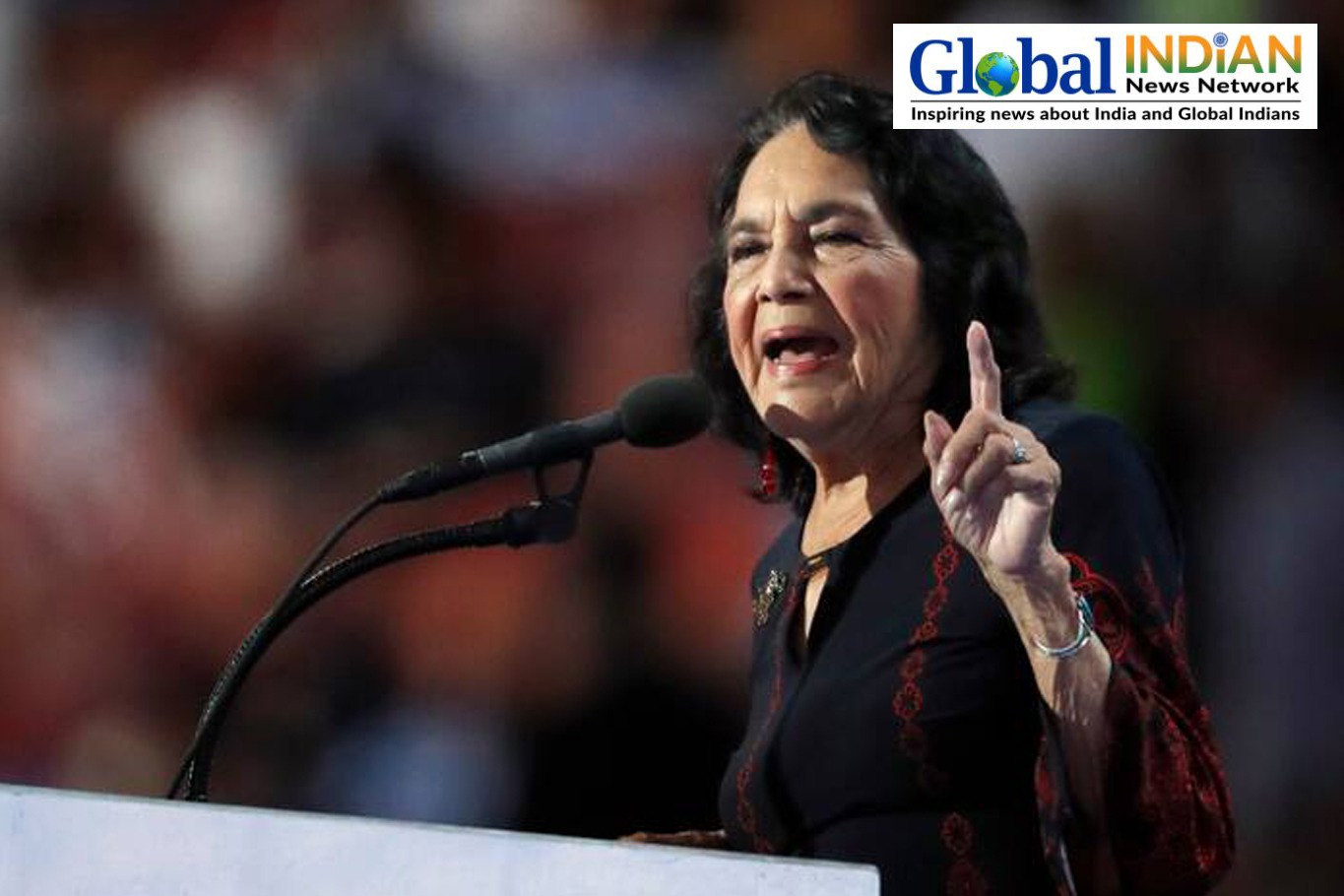
The life and legacy of Dolores Huerta, the renowned labor organizer and civil rights activist, were celebrated through a series of memorial events honoring her decades of work for social justice. Huerta, who died at 96, was remembered not only for her contributions to the American farmworker movement but also for building relationships across ethnic, religious, and cultural communities. Her passing holds particular significance for California’s Indian American community, where she was recognized as a longtime supporter of Punjabi Sikh agricultural workers.
For Punjabi Sikh community member Mani Kang, who knew Huerta for nearly 20 years, the memorial marked both a personal loss and an opportunity to celebrate their enduring friendship. Kang first met her in 2007 during Hillary Clinton’s presidential campaign events in Orange County. Their initial introduction developed into a friendship that continued through political gatherings, community programs, and Democratic National Conventions, where Huerta frequently participated as a delegate.
Although Huerta is widely celebrated for working alongside César Chávez to establish the United Farm Workers (UFW), Kang highlighted another important dimension of her activism: her support for Punjabi Sikh farmers and laborers in California’s Imperial Valley, particularly near El Centro. Punjabi families had established deep roots in the region, with some connected to Mexican American communities through marriages dating back to the early 1900s. Huerta understood that Punjabi Sikh, Filipino, and Mexican American workers faced common challenges involving fair compensation, workplace conditions, and dignity.
Her memorial reflected this inclusive outlook. After becoming the first woman to lie in honor at the California State Capitol in Sacramento, tributes continued in Bakersfield, her longtime home. A public rosary and evening vigil were held November 19 at IBEW Local 428 Hall, followed by an interfaith memorial and celebration of life on November 20 at Dignity Health Arena, attended by thousands.
The interfaith gathering included Hindu, Muslim, and Sikh prayers and readings. Sikh representative Paran Singh Mangat, Muslim representative Aziza Hasan, and Hindu representative Dr. Sudarshan Kapoor participated. California Governor Gavin Newsom, Governor-elect Xavier Becerra, Kathy Spillar, and Kerry Kennedy were among the prominent figures paying tribute. Mariachi performances and traditional Mexican music added to the celebration.
Huerta’s life was also marked by extraordinary courage. She witnessed the events surrounding Senator Robert F. Kennedy’s assassination in 1968. In September 1988, she suffered serious injuries, including two broken ribs and a ruptured spleen, after being beaten by San Francisco police during a peaceful protest against presidential candidate George H.W. Bush. Despite the attack, she continued advocating for workers, political participation, and marginalized communities.
Her enduring slogan, “¡Sí, se puede!” became a rallying cry for collective empowerment. For Kang, Huerta’s greatest legacy was her ability to bring people together, demonstrating that the pursuit of justice transcends cultural and religious boundaries.