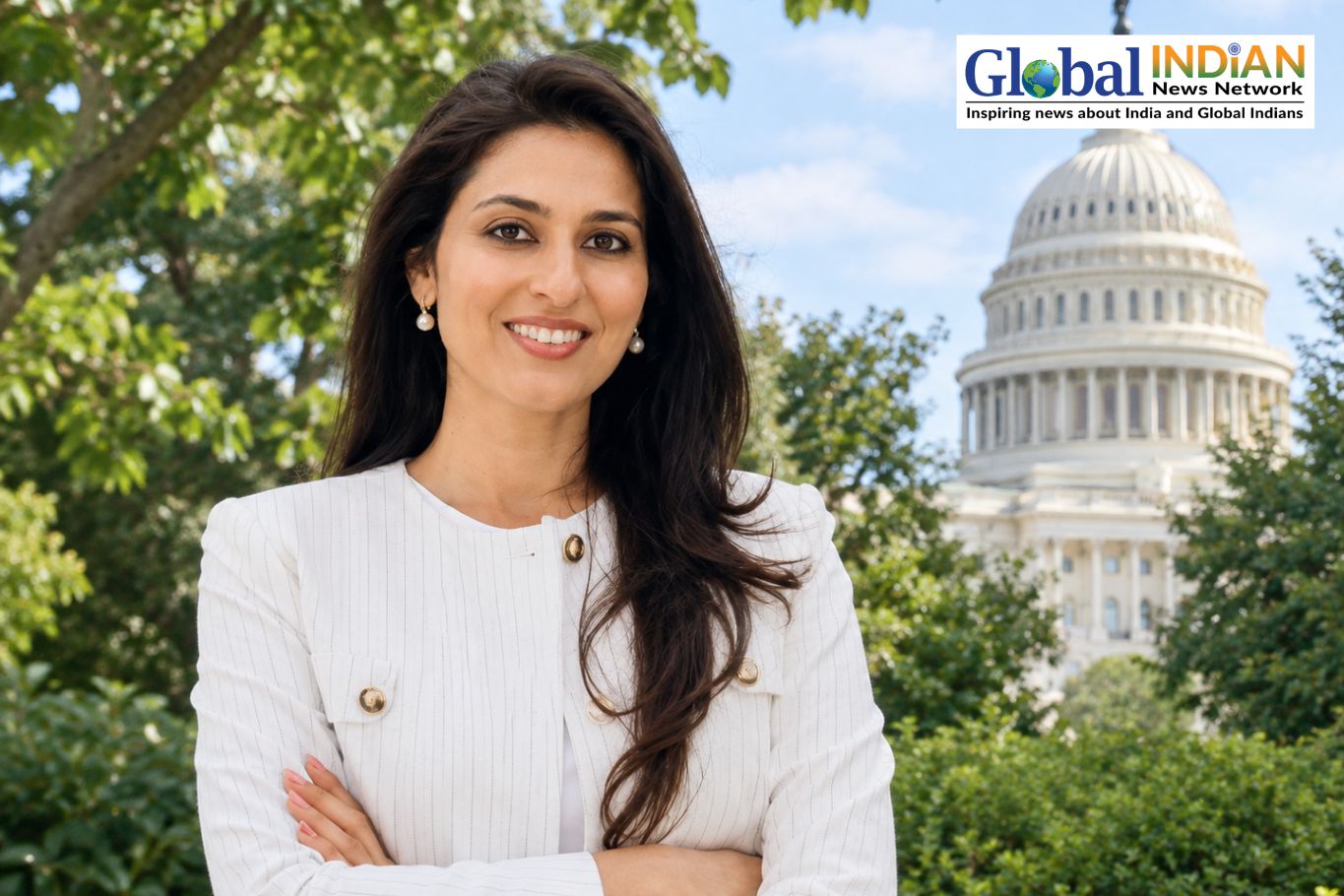
Indian-American educator, former White House Fellow and technology executive Pia Dandiya is seeking to make history in Florida’s 22nd Congressional District, aiming to become the first person of Indian origin to represent the state in the U.S. House of Representatives.
The Democratic nominee is challenging Republican businessman and Marine Corps veteran Casey Askar in a closely watched contest for an open congressional seat. The election is scheduled for November 3, with the race drawing attention to the growing participation of Indian-Americans in American politics.
For Dandiya, the campaign marks her first bid for elected office after a career spanning education, public service and the technology sector.
Born and raised in Palm Beach County, Florida, Dandiya is the daughter of Indian immigrants who settled in South Florida after moving from Jaipur, Rajasthan. Her father, Dr. Rohit Dandiya, pursued a career in medicine, while her mother worked in education.
Her upbringing and family experiences have shaped her political message, which centres on expanding economic opportunities and making the American Dream more accessible to ordinary families.
Dandiya has made affordability a central theme of her campaign, highlighting the rising costs of housing, property insurance and healthcare in South Florida. She has also pledged to address corporate influence in government and strengthen public accountability.
Her platform includes support for public schools, expanded educational opportunities and policies aimed at easing the financial pressures faced by working families.
Dandiya began her professional career as a teacher, working with middle and high school students in economically disadvantaged communities.
At the age of 28, she became the founding principal of a high school in Harlem, New York, making her one of the youngest high school principals in the country. According to her campaign biography, 86 per cent of the school’s students came from low-income families, and every graduate gained admission to college.
The experience helped shape her approach to leadership, with an emphasis on educational opportunity, accountability and putting the needs of the people she serves first.
Dandiya subsequently became a White House Fellow, serving with the Domestic Policy Council and the U.S. Department of Education. Her experience in federal government exposed her to policymaking under both Democratic and Republican administrations.
She later joined Apple, where she worked with state and local governments on technology initiatives designed to modernise education, healthcare and other public services.
Her transition from education and government service to the private sector has become an important part of her campaign narrative, as she presents herself as a candidate with experience across multiple areas of public life.
Dandiya secured the Democratic nomination in Florida’s August 18 primary, defeating attorney Kaysia Earley.
Her campaign has also received support from the Democratic Congressional Campaign Committee, which selected her for its Red to Blue programme. The initiative supports Democratic candidates competing in targeted and potentially competitive House races.
The backing reflects the importance party strategists place on the contest as Democrats seek to gain ground in the House of Representatives.
Dandiya now faces Askar in a race that could bring greater national attention to South Florida’s political landscape and the representation of immigrant communities in Congress.
Dandiya’s candidacy comes amid broader efforts to increase Indian-American representation in the U.S. Congress.
Indian-Americans have established a significant presence in medicine, technology, business, academia and public service. Their participation in electoral politics has also expanded, with several members of the community winning seats in the House of Representatives.
Among the Indian-origin lawmakers identified in the current House are Ami Bera and Ro Khanna of California, Pramila Jayapal of Washington, Raja Krishnamoorthi of Illinois, Shri Thanedar of Michigan and Suhas Subramanyam of Virginia. All six are Democrats and are informally associated with the group known as the “Samosa Caucus,” a reference to their shared Indian heritage.
The composition of this group is expected to change following the 2026 elections. Krishnamoorthi pursued a Senate seat rather than seeking re-election to the House but lost the Democratic primary, while Thanedar was defeated in his congressional primary.
These developments have created uncertainty over the community’s strength in the next Congress, making the outcomes of other Indian-American candidates particularly significant.
In addition to Dandiya in Florida, physician Amish Shah is seeking election as the Democratic nominee in Arizona’s 1st Congressional District.
Indian American Impact, a political organisation dedicated to increasing South Asian representation in American politics, has endorsed both candidates as part of its efforts to expand the community’s political influence.
Dandiya’s personal motivations are closely linked to her experience as an educator and her role as a mother. She and her husband, Navneet Alag, have a son, Sahib, whose future she has cited among the reasons for entering public life.
Her campaign message connects the challenges faced by her former students with the economic pressures confronting families across Florida. She argues that affordable housing, accessible healthcare, strong public schools and greater accountability in Washington are essential to ensuring future generations have opportunities to succeed.
For Indian-American voters and the wider South Asian community, her candidacy represents another opportunity to strengthen representation at the federal level.
A victory in Florida’s 22nd Congressional District would mark a historic milestone for Indian-Americans in the state and add a new dimension to the community’s growing presence in American political life.
As voters prepare to decide the outcome, Dandiya’s campaign highlights the evolving relationship between immigrant heritage, public service and political leadership in the United States.