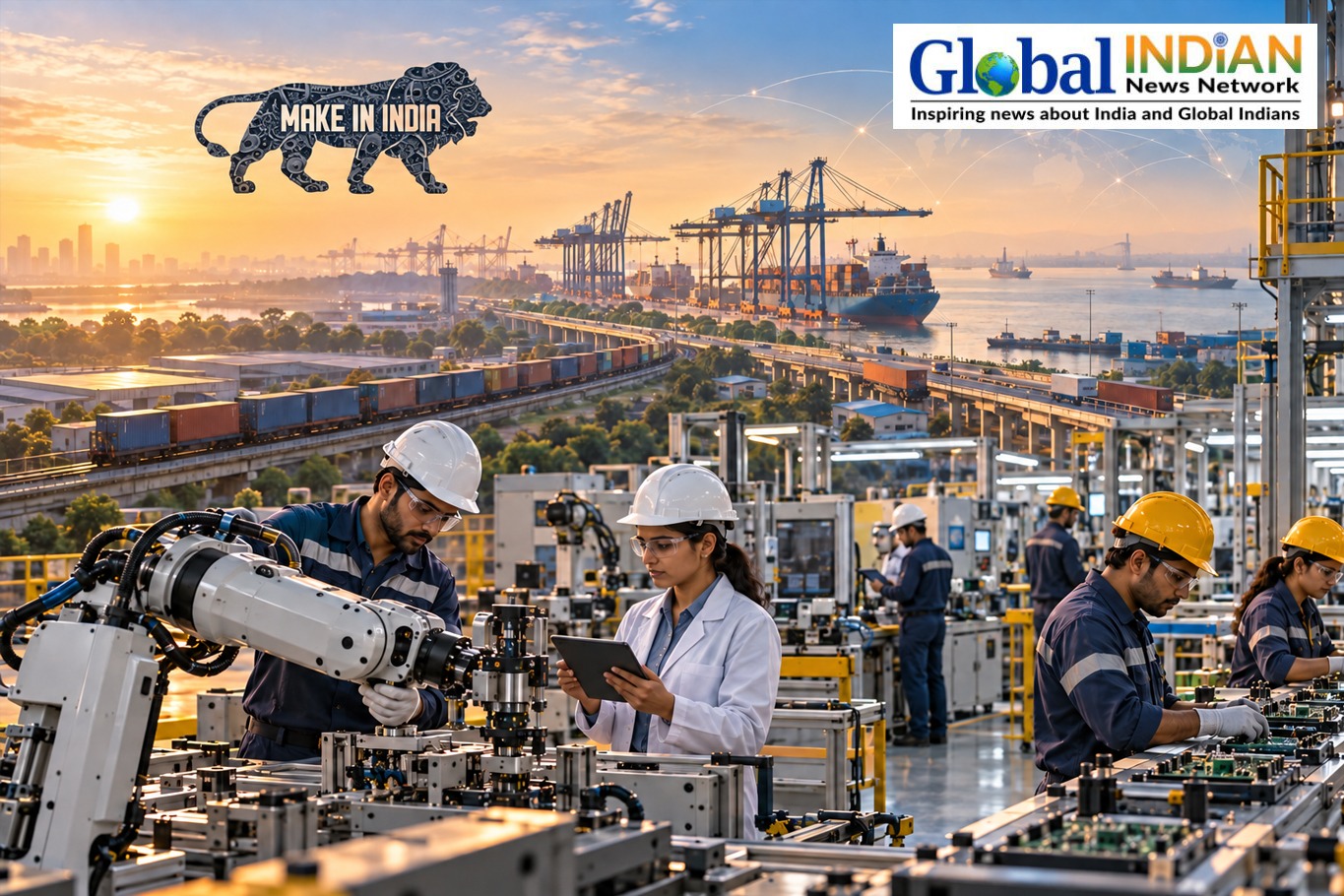
India’s manufacturing strategy is entering a new phase, with greater emphasis on building deeper industrial capabilities rather than simply expanding production. As the Make in India initiative marks 12 years, the Confederation of Indian Industry (CII) has highlighted the need to increase domestic value addition, strengthen supply chains and help Indian companies become more integrated into global production networks.
The initiative has expanded considerably since its launch. While attracting investment and encouraging manufacturing were its initial priorities, the program now encompasses production incentives, industrial infrastructure, innovation, supply-chain development and improved access to international markets. According to CII, the next stage will require particular attention to technology-intensive industries and the creation of stronger domestic capabilities.
Production Linked Incentive (PLI) programs have played a significant role in this transition. As of June 2026, the schemes had drawn actual investments of about $27.27 billion. They had supported production and sales worth approximately $250.5 billion, while exports linked to the programs reached about $164.47 billion. The initiatives had also contributed to more than 1.45 million direct and indirect jobs.
Infrastructure development is another part of India’s manufacturing expansion. Programs such as PM GatiShakti, the National Industrial Corridor Development Programme and BHAVYA are helping build industrial networks and improve connectivity between manufacturing centers and markets. Such infrastructure is intended to support more efficient movement of goods and strengthen the wider manufacturing ecosystem.
CII also pointed to India’s growing network of trade agreements as an important factor in expanding access to international markets. The country has signed nine major trade agreements covering 38 countries, while additional negotiations remain underway. Greater participation in global production networks could create further opportunities for Indian manufacturers to serve international markets.
Looking ahead, CII identified several areas that could shape India’s manufacturing competitiveness. These include increasing domestic technology creation, improving coordination between the central and state governments, simplifying regulatory compliance and enabling more Indian businesses to participate in global value chains.
The shift represents a broader evolution in the Make in India approach—from building manufacturing capacity to developing capabilities that can support sustained value creation and international competitiveness. For Indian industry, the focus is increasingly moving toward technology, resilient supply chains and the ability to compete within interconnected global manufacturing networks.