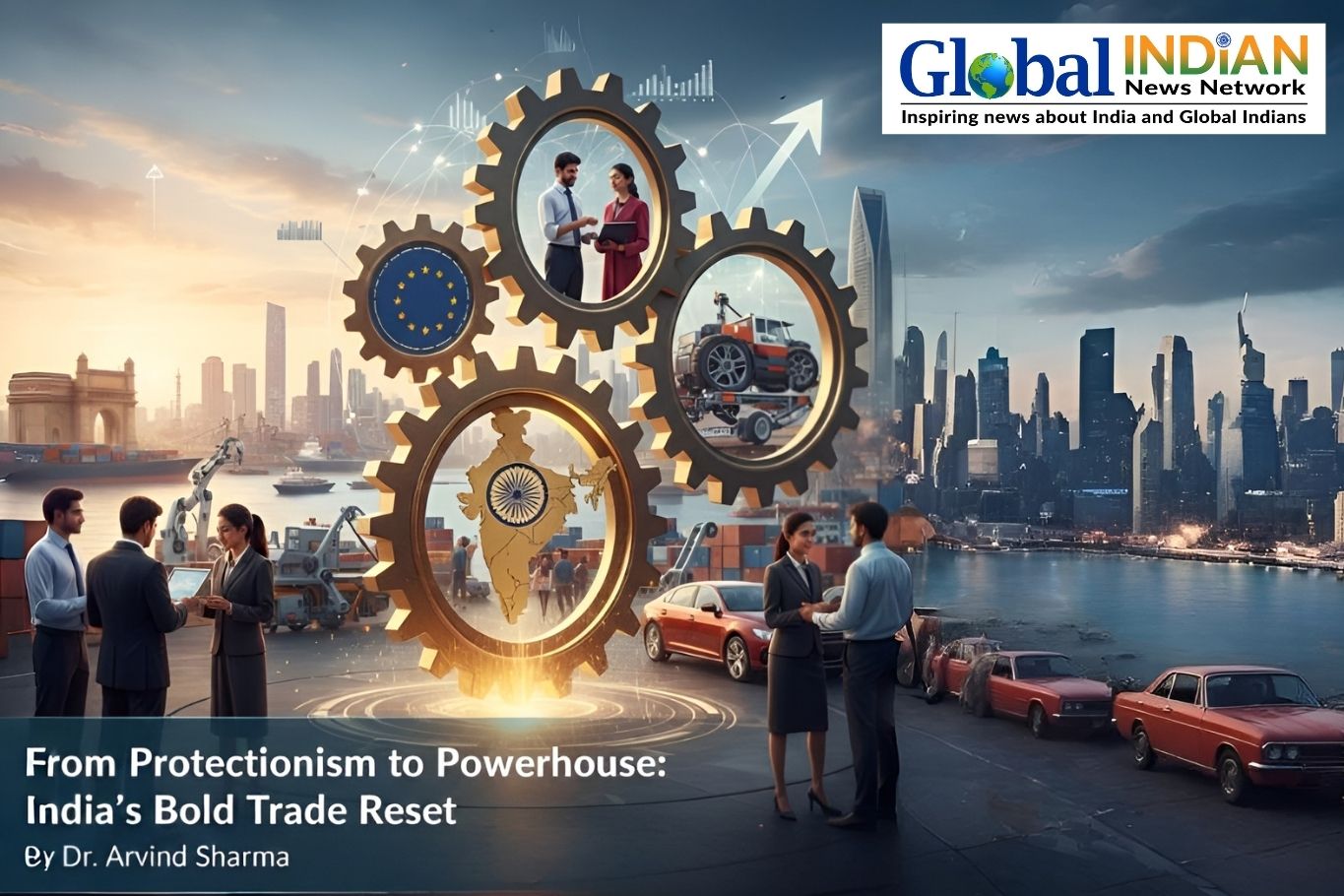
 For decades, India was viewed as a cautious trading nation — protective of domestic industry, guarded in global engagement, and shielded behind tariff barriers shaped in the post-independence era. That chapter now appears to be closing.
A recent international analysis suggests that India may be on the cusp of becoming one of the world’s most open major economies. The shift is not incremental; it is strategic. India is no longer content with peripheral participation in global trade — it aims to compete at the center.
The clearest symbol of this transformation is the India–European Union Free Trade Agreement, concluded after nearly two decades of negotiation. Encompassing a bloc responsible for roughly a quarter of global GDP, the agreement signals India’s willingness to lower tariffs, widen market access, and embed itself more deeply in global value chains. Parallel progress with the United States, the United Kingdom, and other partners reinforces the sense of coordinated openness.
This is not merely diplomacy. It is economic repositioning.
Global supply chains are undergoing structural realignment. Firms seeking alternatives to concentrated production hubs are prioritizing scale, reliability, and skilled labor. India offers these attributes in combination: the world’s largest population, a youthful demographic profile, expanding digital infrastructure, and improving logistics networks.
If policy execution matches ambition, labour-intensive sectors such as textiles, electronics, engineering goods, and auto components could generate millions of jobs. Export volumes could accelerate. Foreign direct investment could deepen. Most importantly, India could begin aligning its demographic dividend with industrial capacity.
Trade agreements alone, however, cannot guarantee prosperity. The durability of this reset depends on domestic reforms — simplifying compliance systems, ensuring regulatory predictability, strengthening infrastructure, and investing heavily in skills development.
Yet the broader signal is unmistakable. India is projecting economic confidence. The narrative is shifting from protectionism to participation, from guarded engagement to competitive integration.
If sustained, this pivot may be remembered as the moment India stepped decisively onto the global stage — not as a protected market, but as a global economic powerhouse.