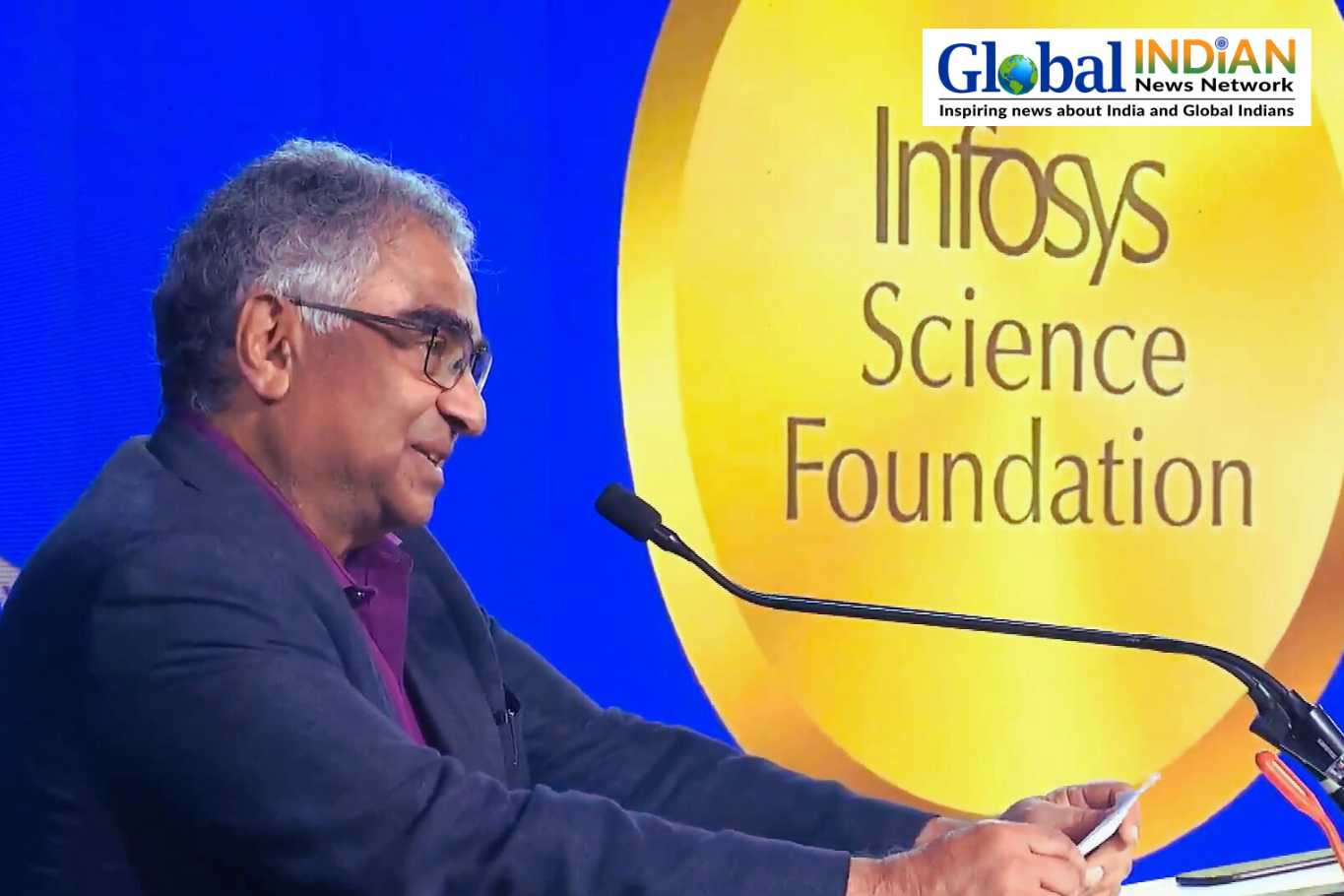
 Before becoming one of the world’s leading astronomers, Shrinivas Kulkarni grew up in a close-knit and highly accomplished family in Karnataka, India. The youngest of four siblings and son of a government doctor, Kulkarni was surrounded by excellence from an early age, with his sisters excelling in medicine, education, philanthropy, and global technology.
Today, Kulkarni, the George Ellery Hale Professor of Astronomy and Planetary Science at Caltech, has been awarded the prestigious Gold Medal by the Royal Astronomical Society (RAS), the highest accolade the London-based institution has presented since 1824. The medal recognized his “sustained, innovative, and groundbreaking contributions to multi-wavelength transient astrophysics,” joining a legacy that includes Einstein, Hawking, and Hubble. Kulkarni is only the second Indian recipient after Subrahmanyan Chandrasekhar and is celebrated for shaping the field of time domain astronomy.
Kulkarni’s academic journey began in Maharashtra and progressed through Hubli and IIT Delhi. His early scientific breakthroughs included the discovery of the first millisecond pulsar in 1982, reshaping understanding of neutron stars. After earning his PhD at UC Berkeley, he joined Caltech on a Millikan Fellowship in 1985 and became faculty in 1987.
Over decades, Kulkarni’s work has unveiled the universe’s most fleeting phenomena. He contributed to the discovery of brown dwarfs in 1995, proved the extragalactic origins of gamma-ray bursts in 1997, and identified a fast radio burst in our galaxy in 2020, linking it to magnetars. Beyond discoveries, he pioneered observational infrastructure, creating the Palomar Transient Factory and its successor, the Zwicky Transient Facility, capturing thousands of cosmic events in real time and revolutionizing optical transient astrophysics.
An instrument builder at heart, Kulkarni has developed 10 major astronomical instruments and continues to work on future missions, including NASA’s Ultraviolet Explorer and the Z Shooter spectrometer at Keck Observatory. He met his wife, Hiromi Komiya, at Berkeley; they have two daughters. His accolades include the Shaw Prize, NSF’s Alan T Waterman Award, and membership in leading scientific academies worldwide.
Kulkarni’s career reflects a fusion of curiosity, innovation, and meticulous craftsmanship, driving humanity’s understanding of the universe while setting new benchmarks in astronomical research.