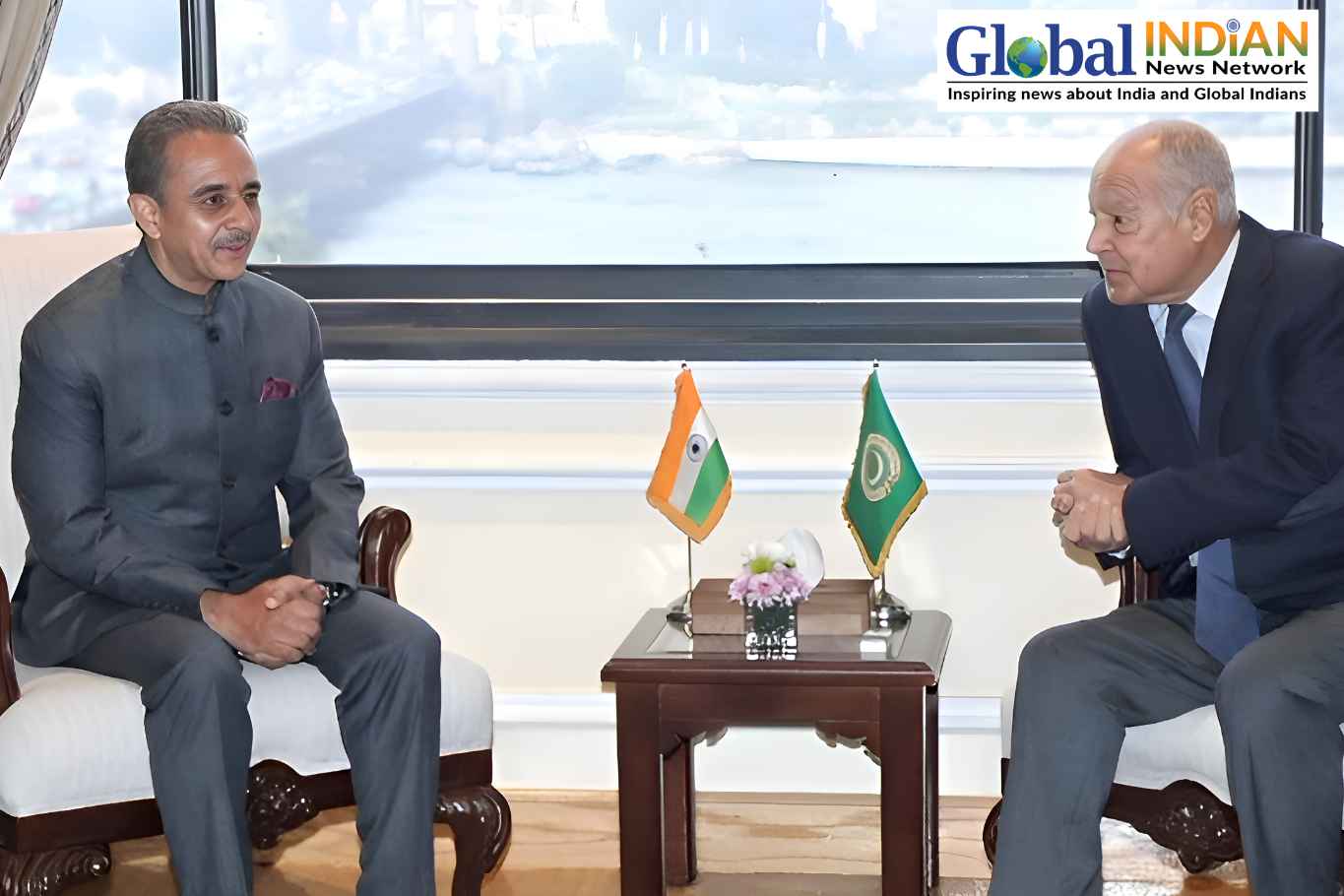
 India and the League of Arab States reaffirmed their commitment to strengthening bilateral engagement during a high-level meeting held in Cairo. Minister of State for External Affairs Kirti Vardhan Singh met Arab League Secretary General Ahmed Aboul Gheit to review cooperation across political, economic, and cultural sectors.
The discussions highlighted the broad scope of India’s engagement with the Arab League and emphasized shared interests in expanding collaboration. Both sides welcomed the upcoming second India–Arab Foreign Ministerial Meeting, scheduled to take place in New Delhi later this month, viewing it as an important platform to advance dialogue and partnership.
Following the meeting, Singh shared that the interaction was productive and focused on deepening ties between India and the Arab League. The talks reflected ongoing efforts by both sides to maintain momentum in diplomatic exchanges and institutional cooperation.
India’s engagement with the Arab League has also been reinforced through regular consultations. In November last year, senior officials from India’s Ministry of External Affairs held discussions with Arab ambassadors in New Delhi, reviewing measures to further enhance cooperation and coordination between India and Arab nations.
India shares long-standing and friendly relations with Arab League members, rooted in centuries-old connections through trade, scholarship, and cultural exchange. These historical interactions, facilitated by maritime and land routes linking India with West Asia and the Arab Peninsula, created enduring bonds that continue to influence modern relations. Cultural linkages, including shared linguistic and religious influences, remain an important foundation of these ties.
The Arab League, established in Cairo in 1945, has grown from seven founding members to 22 countries across North Africa and the Middle East. These nations form a crucial part of India’s extended neighborhood and play a significant role in regional and global affairs.
India’s strategic engagement with Arab countries is supported by strong economic and commercial links. Key global trade routes passing through the Suez Canal, the Red Sea, and the Gulf of Aden are vital for India’s external trade, underlining the region’s importance to India’s economic interests.
Over the past decade, India and Arab countries have entered a phase of renewed cooperation, driven by economic reforms, development priorities, and shared perspectives on global issues. This evolving partnership is increasingly focused on sustainable growth, trade expansion, and deeper political understanding, reinforcing the long-term strength of India–Arab relations.