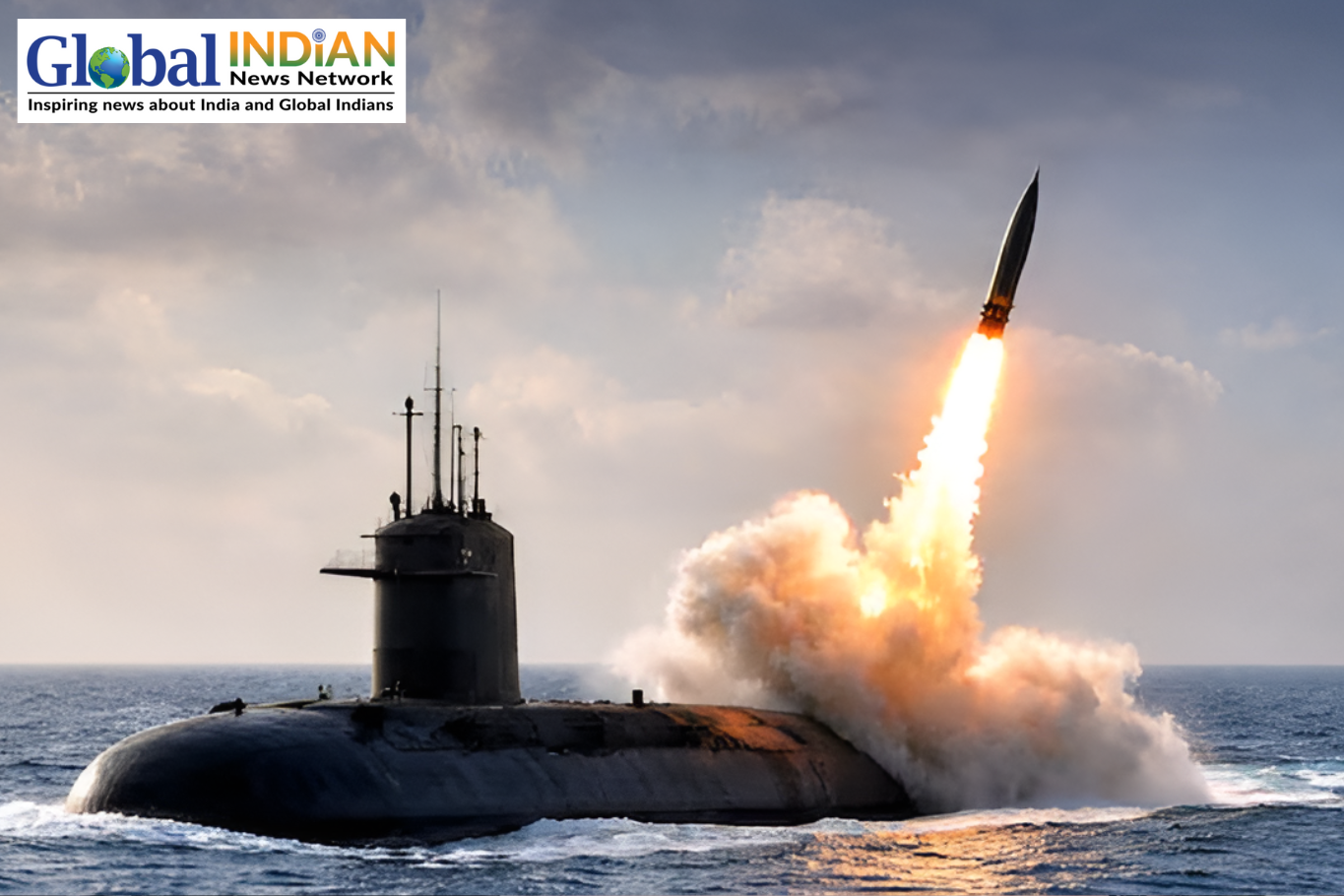
 India recently conducted a successful test of its K-4 submarine-launched ballistic missile (SLBM) from the nuclear-powered submarine INS Arighaat in the Bay of Bengal. This test represents a critical step in India’s ongoing efforts to expand its undersea nuclear deterrent. The K-4, capable of carrying a 2-ton warhead, boasts an impressive range of 3,500 kilometers, providing a significant boost to India’s strategic reach compared to the earlier K-15 missile, which had a range of only 700 kilometers.
Developed by the Defence Research and Development Organisation (DRDO) and produced by Bharat Dynamics Limited, the K-4 is specifically designed for the Arihant-class submarines, including INS Arihant and INS Arighaat. Measuring 10–12 meters in length and weighing 17–20 tonnes, this two-stage solid-fuel missile employs GNSS navigation, including India’s indigenous NavIC system, ensuring precision guidance for long-range operations.
The successful test signals a transition from experimental trials to operational readiness and user training, indicating that the missile will soon be fully integrated into India’s nuclear submarine fleet. This development enhances India’s second-strike capability, a core component of its nuclear doctrine that emphasizes Credible Minimum Deterrence and a No First Use policy. Submarine-launched weapons such as the K-4 provide the stealth and survivability needed to ensure retaliation after a potential first strike, strengthening strategic stability in the region.
Strategically, the Indian Ocean has become a highly contested theater with China expanding its influence, the US balancing in the Indo-Pacific, and regional actors like Japan, South Korea, Malaysia, and Indonesia remaining vigilant. The K-4 missile allows India to project its power more effectively, mitigate regional threats, and reinforce deterrence against potential adversaries. As India continues to expand its SSBN fleet, the nation is positioning itself to maintain a commanding presence across the Indian Ocean, ensuring both defensive and strategic leverage.
In summary, the K-4 test underscores India’s commitment to enhancing its maritime nuclear capabilities, delivering a substantial leap in regional deterrence and bolstering its influence across critical Indo-Pacific waters.