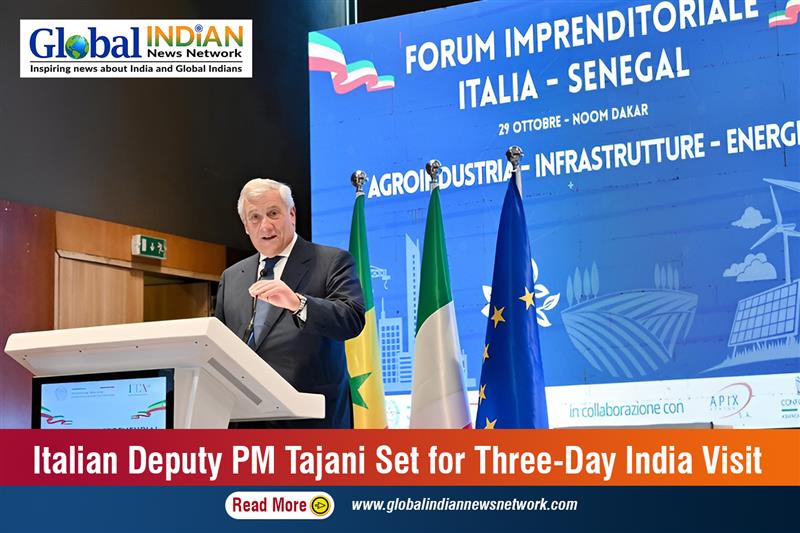
 Italian Deputy Prime Minister and Foreign Minister Antonio Tajani will arrive in India on Wednesday for a three-day official visit aimed at strengthening political, economic, and strategic cooperation between the two countries. According to the Ministry of External Affairs, Tajani will hold discussions with External Affairs Minister S. Jaishankar in New Delhi before travelling to Mumbai for a series of meetings and official engagements on Thursday. He is scheduled to depart from Mumbai on Friday.
The visit comes amid renewed momentum in India–Italy relations, highlighted by the meeting between Prime Minister Narendra Modi and Italian Prime Minister Giorgia Meloni on the sidelines of the G20 Summit in Johannesburg last month. The two leaders reviewed ongoing cooperation and identified new areas for partnership, including trade, investment, defence, innovation, artificial intelligence, space, and education.
Following their discussions in Johannesburg, Prime Minister Modi said the India–Italy Strategic Partnership was “growing from strength to strength” and delivering significant benefits to both nations. The leaders also announced a joint initiative to enhance cooperation in combating the financing of terrorism, calling it a timely step toward strengthening global security efforts.
Tajani and Jaishankar last met in September on the sidelines of the United Nations General Assembly in New York, where they held talks on regional developments in the Mediterranean, the Middle East, Ukraine, and the Indo-Pacific, alongside bilateral issues.
India and Italy share a longstanding diplomatic relationship that began in 1947. The two countries marked the 75th anniversary of their ties in 2023, reflecting deepening cooperation across strategic and economic sectors. Italy remains India’s fourth-largest trading partner within the European Union, after Germany, Belgium, and the Netherlands, and hosts a vibrant Indian diaspora contributing to cultural and economic engagement.
Tajani’s visit is expected to reinforce high-level exchanges and set the stage for expanded collaboration as both nations reshape their diplomatic and economic priorities in an evolving global landscape.