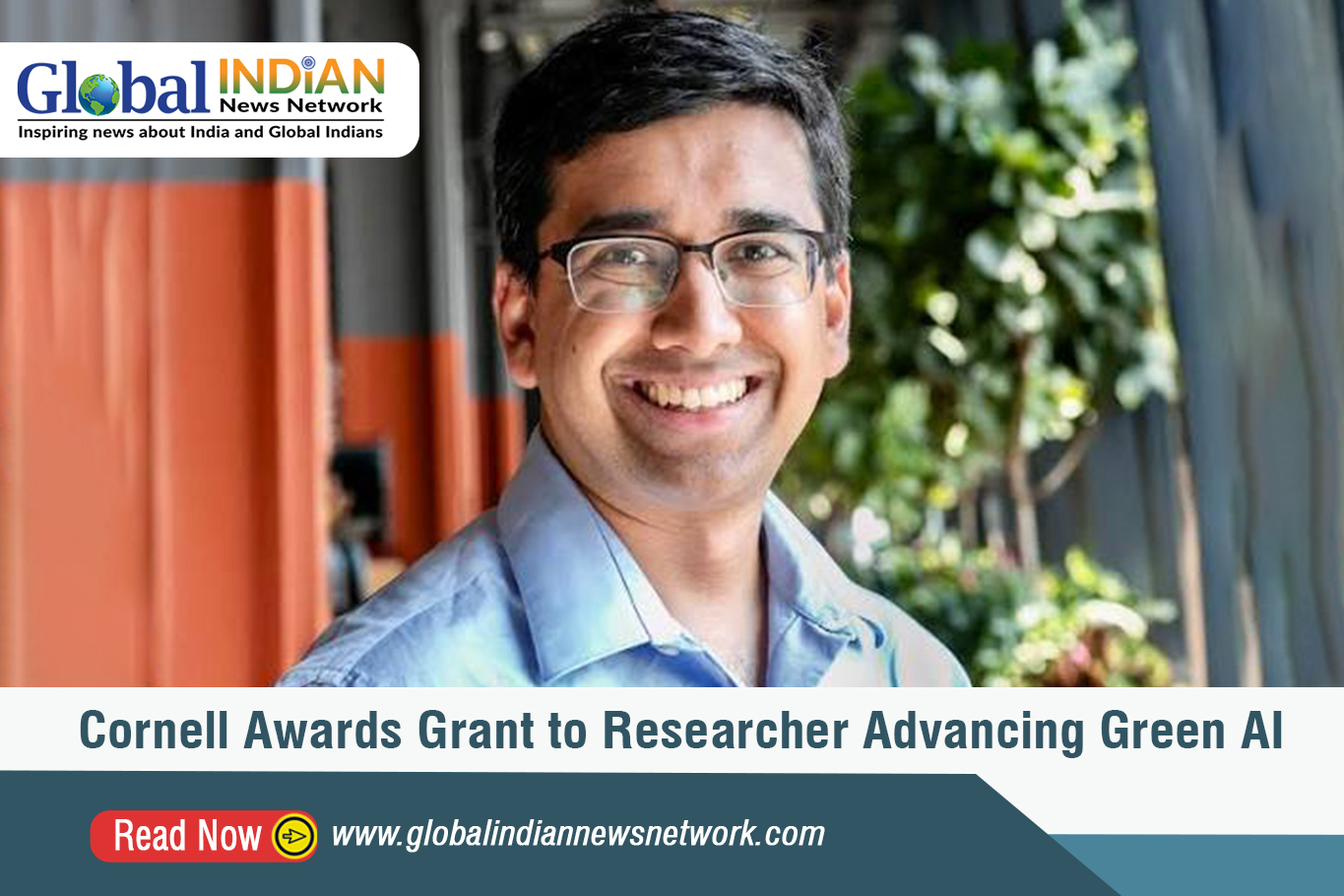
 Indian American scholar Dr. Udit Gupta, an assistant professor of electrical and computer engineering at Cornell Tech, has been selected as one of the first recipients of Cornell’s AI and Climate Fast Grant. His project focuses on developing new approaches to cut the rapidly increasing energy demand associated with artificial intelligence while exploring ways AI can support environmental research.
Gupta is one of eight Cornell researchers awarded between $10 thousand and $25 thousand in funding under The 2030 Project: A Cornell Climate Initiative. The program supports groundbreaking work that lies at the intersection of climate science and artificial intelligence, recognizing the growing environmental burden of large-scale AI systems.
Recent studies from Cornell Engineering have highlighted the scale of this challenge. If AI usage continues to expand at the current pace, global emissions from AI could reach between 24 million and 44 million metric tons of carbon dioxide by 2030. Water use tied to AI infrastructure may also soar, potentially requiring between 731 million and 1.125 billion cubic meters of water.
Gupta’s research aims to counter these alarming trends through a new system called “EcoGPT,” a generative AI interface designed to shrink AI’s carbon footprint by accepting slightly slower response times. He explained that industry data shows even minor delays—just a few hundred milliseconds—can boost system throughput and energy efficiency by up to 2.5 times. The project will include user studies to understand how people react to greener AI trade-offs, producing valuable data that companies can use when designing more sustainable service options.
His broader work sits at the intersection of computer architecture, machine learning, and sustainable systems. He develops cross-layer solutions, spanning hardware, algorithms, systems, and applications, to increase the efficiency and scalability of next-generation computing. Gupta has previously helped shape the design of AI hardware by leading the characterization of industry-scale personalized recommendation models.
His team’s open-source benchmarks, now incorporated into major community standards like MLPerf, have guided the development of hardware-software co-design strategies that save substantial computing resources across the AI industry. His contributions emphasize integrating environmental sustainability as a foundational consideration in system design.
Gupta’s accomplishments have been featured in Bloomberg Green, The Guardian, and CNBC. His honors include multiple IEEE Micro Top Picks, best paper nominations, and distinguished dissertation awards. He holds a PhD in computer science from Harvard University and a bachelor’s degree in electrical and computer engineering from Cornell University.