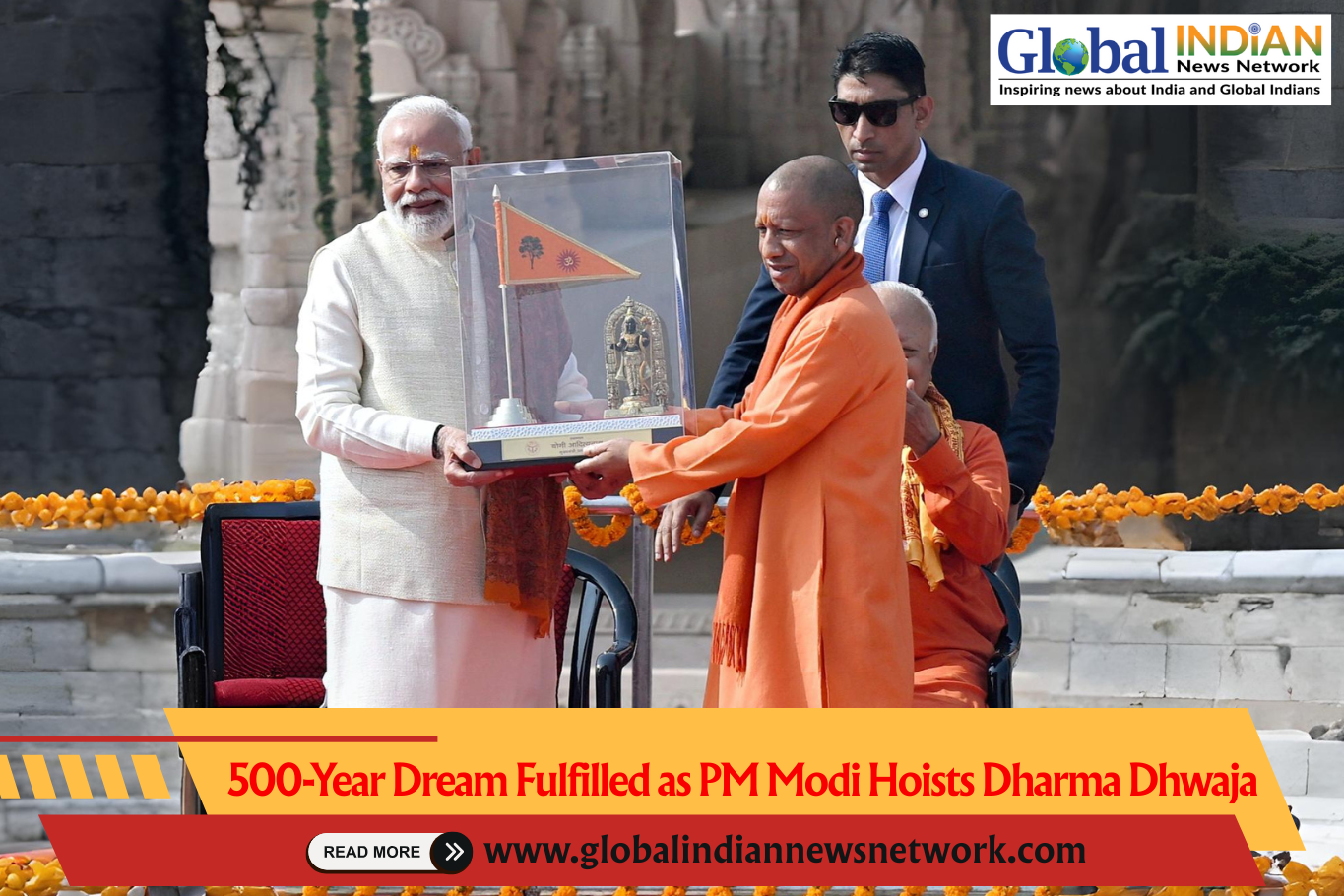
 On Tuesday in Ayodhya, chants of devotion and emotion echoed as Narendra Modi hoisted the newly-designed sacred saffron banner known as the Dhwajarohan Utsav at the Ram Janmabhoomi Temple, a moment greeted by saints, seers and devotees from across the nation who described it as the realisation of a 500-year-old dream.
Speaking to the press, one of the attending saints, Raju Das, said, “After 500 years, the dream has been fulfilled. Many in Ayodhya know that I was once arrested at Ghanta Ghar and spent 40 days in jail. Why? Because at Hanuman Garhi, if someone didn’t say ‘Jai Shri Ram’, were they expected to chant something else? That was the situation then — just for proclaiming devotion. Today, every heart is rejoicing.”
Other religious leaders voiced similar sentiments. One remarked, “It was a moment of immense pleasure. Today, after 500 years, the Ram Mandir stands officially complete. PM Modi is not just a leader; he is a Mahapurush guiding a historic transformation.” Mahant Tulsi Das added: “This moment fills the entire nation with happiness.” Mahant Kamal Nayan Das reflected, “I felt truly honoured. This is a milestone for the country’s spiritual and cultural future.” Saint Anuj Das said: “This Dharma Dhwaja is truly a Rashtradhwaja. Whatever PM Modi did today was entirely in the spirit of faith, not politics.
Commenting on the event’s broader meaning, Parshotam Dadichi, President of the Shri Sanatan Dharma Sabha, observed: “The foundation of a temple is not merely a construction event — it marks the birth of values that define a nation. After the Shila Poojan and the installation of Ram Lalla in the Garbh Griha, today’s flag hoisting represents India rising as a global spiritual force. This message radiates positivity not only for our nation but for the entire world.”
The ceremony at approximately noon saw PM Modi together with Mohan Bhagwat, head of the Rashtriya Swayamsevak Sangh, perform the formal hoisting of the specially-designed saffron flag atop the temple spire. The flag, measuring 22 feet in length and 11 feet in width, was crafted by a parachute specialist from Ahmedabad, Gujarat. It weighs between 2 and 3 kg and has been engineered to endure high altitude and strong winds. The motif includes the Sun symbol — representing Lord Rama’s Suryavanshi lineage — along with the Kovidara tree, the Sun and the Om symbol. Its colour, saffron, signifies fire, the rising sun, sacrifice and dedication.
Earlier in the day, PM Modi also visited the Sapt Mandir inside the temple complex, offering prayers. These seven shrines honour the revered sages Maharishi Vashistha, Maharishi Vishwamitra, Maharishi Agastya, Maharishi Valmiki, Goddess Ahalya, Nishadraj Guha and Mata Shabari — each a pivotal figure in Lord Rama’s life and journey.
With this ceremony, Ayodhya’s cultural and religious renaissance has taken another significant stride forward. For many, the hoisting of the Dharma Dhwaja is not just a ceremonial act but a potent symbol of India’s enduring civilisational ethos, renewing faith, national sentiment and spiritual purpose